

02 September . 2026
Renting vs. buying: A 5-year cost breakdown (no fluff, just math)
The choice between renting and buying a home is one of the biggest financial decisions we make. But it’s not an apples-to-apples comparison, which can make it difficult to know which is the better choice. Not to mention that the “winner” is the one that makes financial sense over the long run, not just today.
When you rent, your monthly payment covers the cost of a temporary place to live. There are plenty of benefits: you have fewer upfront costs, it’s someone else’s job to fix that leak, and if you decide your neighborhood isn't your vibe anymore, you can move fairly easily.
When you buy, a portion of your mortgage payment goes toward the home you own. As rents continue to rise and your mortgage stays the same, owning eventually becomes cheaper than renting. Plus, you’ll be gaining equity, a valuable financial resource to help you fund major life goals, deal with emergencies, or give you more options down the road.
There are lots of reasons you might want to rent or buy that have nothing to do with money—but in this blog, we’re here to help you run the numbers.
Is it better to rent or buy in Hillsboro, Oregon?
For this 5-year example, we'll use a $520,000 home and a $2,400 monthly rent. These numbers are designed to give us a reasonable Portland-area comparison, not a prediction of what any specific home or apartment may cost.
We’ll assume:
- Rent increases by 5% each year (about half the maximum allowed)
- You put 10% down on the home: $52,000
- 30-year fixed mortgage at 6.5%
- 3% average annual home appreciation
Note that these are hypothetical numbers meant to illustrate how the math works. Your actual costs could look different depending on your mortgage rate, home price, taxes, insurance, maintenance, and what happens in the housing market.
Year 1: Renting
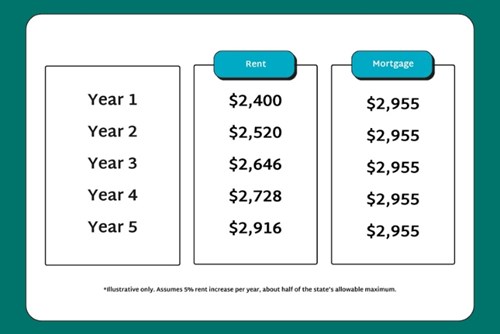
Renting can be a great option. At $2,400 a month, your first year of rent costs $28,800. But there’s one big problem with rent, which is that it always goes up. And up. And up. In Oregon, 9.5% is the current maximum allowable annual rent increase.
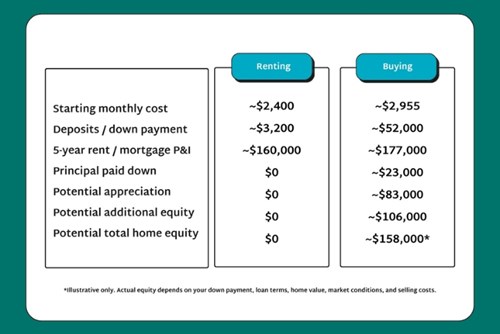
If your rent increases by even 5% each year, in five years you’ll be paying $2,916 per month. That means you’ll have forked over about $160,000 of your paycheck to rent.
Year 1: Buying
Now let's say you buy that $520,000 home. You put down $52,000 and take out a $468,000 mortgage. At a hypothetical 6.5% rate, your mortgage payment would be around $2,955 per month.
That's more than the $2,400 rent. And that's before property taxes, insurance, and maintenance. But here's where the math gets interesting…

Your mortgage payment isn't just disappearing
Every mortgage payment has two main pieces: interest and principal. Interest is the cost of borrowing the money. Principal reduces the amount you owe.
Over five years, you'd pay down approximately $23,000 of your original mortgage balance. That's money that has effectively moved from your bank account into your ownership stake in the home. And then there's potential appreciation.
Let's assume your $520,000 home appreciates by an average of 3% per year. After five years, it could be worth around $603,000. That's approximately $83,000 in potential appreciation. Add the roughly $23,000 you've paid toward principal and your original $52,000 down payment, and you’ve got about $158,000 in total potential equity—almost the same amount as the rent you would have paid.
Renting vs. buying: a side-by-side breakdown
When you put the two scenarios side by side, you can see that renting and buying put your money to work in different ways. With renting, your housing payment is an expense. With buying, some of your payment can become equity. And that distinction starts to get pretty significant over a five-year period.
Homeowners who itemize deductions and meet applicable requirements may also be able to deduct mortgage interest and state and local real estate taxes. But tax benefits vary based on your individual circumstances, so think of them as a possible financial bonus—not the reason you're opening Zillow.
When is buying the right move?
If you think you'll move in less than two years, buying might not make sense. If you don't have enough savings, you may not be ready. And if you love renting? Keep renting.
The question to ask yourself is, “What do I want the next five years to look like?”
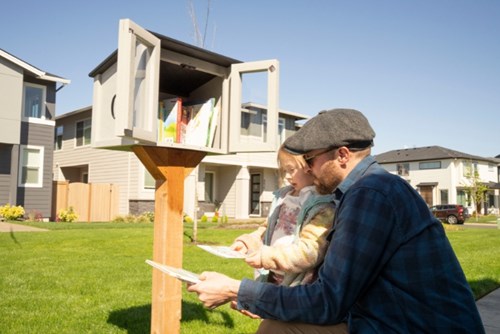
The thing about buying a home that doesn't show up in the math is that you’re also buying a life. Maybe you want a home office that isn't your dining table, a yard for your pup to zoom around, and a neighborhood where you can grab coffee or groceries without getting in the car. Or maybe you're just ready for your home to be more than a temporary stop.
Somewhere beyond the math
If you've decided that the Portland area is where you want to put down roots, a new-home community like Reed's Crossing offers one example of what that next chapter can look like. There are a variety of home sizes and styles, including attached homes for buyers who want the benefits of homeownership without all the maintenance. Many homebuilders also offer incentives you won’t get in the resale market, like closing cost assistance or mortgage rate buydowns, making buying more attainable.
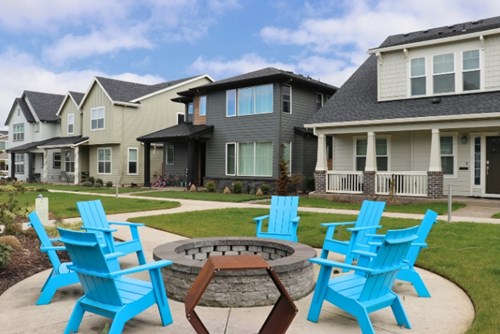
And then there's everything outside the floorplan. Parks. Paths. Gardens. Wildlife. Libraries. Schools. Firepits. Community events. And Town Center for shopping, dining, groceries, and everyday errands.
It's less “We bought a house” and more “We found where we want to be,” and that's worth thinking about when you're comparing rent vs. mortgage. Because you're not just deciding what you can afford each month; you're deciding to start building something that's truly yours.
Want to see how the math could work for you? Come visit our Model Home Village & chat with a builder, take a virtual tour, or sneak a peek at what’s in store for the future.